Hiring a B2B SaaS content writer should make your content operation lighter.
But too often, it does the opposite.
A writer turns in a draft for an “alternatives to [competitor]” article. Technically, it follows the brief. The keyword is in the H1, the competitors are listed, and the article even has a comparison table.
But the piece does not explain why buyers are leaving that competitor, which use cases matter most, how your product is different, or what objections the reader is likely weighing before booking a demo.
The examples are broad enough to apply to any SaaS company, and the product mentions feel like they were added after the fact.
Now, you have to fix the positioning, add product context, rewrite the examples, and turn a generic SEO draft into something an actual buyer can use. That is the work you hired the writer to avoid.
The right freelance B2B SaaS content writer should understand your product, your ICP, your funnel, and the business goal behind the content.
In this guide, I’ll walk through how to hire one, what to look for, what to ask, what to pay, and how to avoid bringing on a writer who creates more work for your team.
What does a B2B SaaS content writer do?
A B2B SaaS content writer turns product, customer, and market knowledge into content that helps buyers understand a problem, evaluate solutions, and move closer to a decision.
That sounds simple until you look at what the job really involves.
A good SaaS writer does not just take a keyword and write 1,500 words around it.
In my experience writing for B2B SaaS companies, the hardest part is rarely the sentence-level writing. It is understanding the context behind the article: who the buyer is, what stage of the journey they are in, what pain brought them to the article, and how your product fits into the conversation.
For example, a generic writer may see the keyword “best project management software” and create a list of tools. A stronger SaaS writer will ask better questions:
- Who is searching for this?
- Are they a founder, project manager, operations lead, or agency owner?
- What are they switching from?
- What features do they care about?
- What objections might stop them from choosing your product?
- How should your product appear without making the article feel like a sales pitch?
When I’m working on product-led or bottom-funnel content, I usually spend as much time understanding the product and buyer as I do outlining the article. That might mean reviewing product pages, watching demos, reading help docs, checking customer reviews, or looking at how competitors frame the same problem.
That is the difference between filling a blog and creating content that helps buyers make decisions.
A B2B SaaS content writer may also work on educational blog posts, product-led articles, comparison pages, alternatives posts, use case pages, content refreshes, sales enablement assets, case studies, newsletters, or thought leadership pieces.
In practice, they are less like typists and more like translators. They translate product knowledge, customer pain, search intent, and internal expertise into content your buyers can understand.
When should you hire a B2B SaaS content writer?
That you’re reading this piece tells me you’re already considering hiring a writer.
But are you ready? Here’s how to know.
Hire a B2B content writer when content is an important growth lever, but your team no longer has the bandwidth or specialist skill to execute well.
For many SaaS teams, the first sign is a full content calendar with too few hands to move the work forward.
You may already have:
- Keyword research sitting in a spreadsheet
- A content calendar with topics mapped out
- Product launches that need supporting content
- Old articles losing rankings and waiting for refreshes
- Sales asking for bottom-funnel and objection-handling content
- A CEO or founder with thought leadership ideas they want published
- A backlog in Notion, Asana, Airtable, or one chaotic Google Doc that keeps getting longer
I’ve seen this happen with content teams that already have good ideas.
The issue is not that they do not know what to publish (If that’s your case, you might need a strategist first). Rather, it is that every article still needs research, outlining, drafting, product context, internal links, SME review, editing, and optimization.
The bottleneck becomes getting strong content out the door without lowering the bar.
That is when a freelance SaaS content writer can help.
A writer is probably worth hiring if your team has a clear content direction but needs help turning briefs, ideas, interviews, or old articles into publish-ready pieces.
They can also help when your publishing cadence is inconsistent, your content manager is spending too much time rewriting drafts, generalist writers keep missing the product nuance, or your current content gets traffic but does not drive demos, trials, or signups.
The best time to hire is when you can give the writer enough direction to succeed, but not so much hand-holding that outsourcing defeats the point.
Do not hire a writer yet if you do not know your ICP, have no topic priorities, or expect one person to fix your entire content strategy, positioning, SEO, distribution, and attribution.
A writer can help you execute and improve your content. They should not have to reverse-engineer your whole go-to-market strategy from three homepage screenshots and a vague brief that says, “Make it rank.”
Before you hire, decide what type of SaaS content writer you need
“B2B SaaS content writer” is too broad. Before you hire, get clear on the kind of content work you actually need help with.
Some writers fit neatly into one lane. Others combine a few.
For example, a writer may be both an SME-led writer and a bottom-funnel writer if they know how to interview experts and turn those insights into comparison and alternative articles or product-led articles.
The point is not to put writers into rigid boxes. It is to avoid hiring a talented writer for the wrong job.
This table gives a quick overview of the different types of B2B SaaS writers you might come across.
| Type of SaaS content writer | Best for | What to look for |
| SEO content writer | Search-led blog posts, content refreshes, keyword-focused articles, and organic traffic growth | Strong understanding of search intent, article structure, on-page SEO, internal linking, and content optimization |
| Product-led content writer | Articles that naturally show how your product solves the reader’s problem | Ability to understand product workflows, use screenshots or examples, and connect features to real use cases without making the article feel like a sales pitch |
| Bottom-funnel content writer | Comparison and alternative posts, best lists, use case content, and decision-stage articles | Understanding of buyer objections, competitor positioning, commercial-intent keywords, and how readers evaluate software |
| SME-led content writer | Thought leadership, expert interviews, original insights, and content that should not sound like a remix of the SERP | Strong interview skills, curiosity, ability to extract useful insights, and experience turning expert input into clear content |
| Technical SaaS writer | Developer tools, cybersecurity, data, AI, infrastructure, and complex software categories | Ability to understand technical concepts, ask precise questions, and explain complex topics without oversimplifying |
| Strategist-writer | Teams that need help choosing topics, shaping briefs, or identifying content opportunities | Content judgment, funnel awareness, keyword prioritization, business context, and the ability to suggest better angles |
| Generalist SaaS writer | Lower-stakes blog posts, simple educational content, or teams with very detailed briefs | Clear writing, reliability, ability to follow instructions, and enough SaaS familiarity to avoid generic explanations |
Hiring the wrong type of writer is like hiring a great goalkeeper to play striker. They may be talented, but they are not solving the problem you have.
So before you start looking, ask:
- Do we need traffic, conversions, sales enablement, thought leadership, or content refreshes?
- Will this writer receive detailed briefs, or do we need help shaping the angle?
- Do they need to interview SMEs?
- Do they need product access?
- Are we mostly publishing top-of-funnel or bottom-funnel content?
- Do we need strategy, execution, or both?
The clearer the content job, the easier it is to spot the right writer.
What to look for in a B2B SaaS content writer
The best SaaS writers combine writing ability with product understanding, research skills, SEO judgment, and business context.
A clean sentence is not enough.
For a B2B SaaS team, the writer also needs to understand how software is bought, evaluated, implemented, and justified internally.
Your buyer is not only reading for education. They may be comparing options, preparing a business case, trying to solve a painful workflow problem, or looking for proof that your product can do what your marketing claims.
Look for these signals.
SaaS experience
The writer does not need to have written for your exact category, but they should understand how SaaS companies work. That includes recurring revenue products, feature-led messaging, sales cycles, integrations, use cases, and the difference between a casual reader and a software buyer.
Product understanding
A good SaaS writer should want to see the product, watch a demo, review screenshots, understand workflows, or at least study your help docs and product pages.
If they are writing about your product without trying to understand how it works, the article will probably feel generic.
Search intent judgment
SEO is not just placing a keyword in the title and H2s.
The writer should know why someone is searching, what they expect to find, how much they already know, and what kind of answer would actually satisfy the query.
Research process
Ask how they gather information.
Do they interview SMEs? Review customer calls? Read customer reviews? Analyze competitors? Use product documentation? Pull examples from real workflows?
Or do they just summarize what already ranks?
Business judgment
Strong writers understand that content has a job.
Sometimes the job is traffic. Sometimes it is demo requests. Sometimes it is sales enablement. Sometimes it is helping a buyer understand why your product is different.
The writer should understand the goal before they start drafting.
Editorial independence
The writer should reduce your workload over time.
If every draft requires you to rebuild the argument, fix positioning, add examples, and explain the product again, you might as well do it yourself from the start.
How to evaluate a B2B SaaS content writer
Do not evaluate only the final published sample. Evaluate how the writer thinks.
Ask what role the writer played in the piece.
This question is especially important because a published sample can hide a lot. I’ve had pieces improved by great editors, and I’ve also delivered drafts that needed very little editing before publication.
Both situations happen. What you want to understand is how the writer thinks before the editorial layer is added.
Did they own the outline? Did they interview the SME? Did they use the product? Did they receive a detailed brief, or did they shape the angle themselves? How much editing happened before publication?
Also, look for relevant samples, not just impressive logos.
A writer who has written polished top-of-funnel explainers for a major brand may still struggle with a bottom-funnel “alternatives” page for your niche SaaS product. The logo is nice. The content type matters more.
When reviewing samples, look for:
- Clear structure
- Strong introductions
- Specific examples
- Product or industry understanding
- Helpful explanations
- Search intent alignment
- Natural product mentions
- Original insight
- Reader empathy
- Strong takeaways
If you are close to hiring, use a paid test piece or short pilot.
Do not ask for unpaid custom work, please. Instead, give the writer a real topic and evaluate how they handle the process.
Pay attention to the first draft, but also watch how they respond to feedback.
A good writer gets closer to the target after feedback. A great one starts asking better questions, learning your product faster, and making your editorial process lighter.
Questions to ask before hiring a B2B SaaS content writer
Good questions reveal process, judgment, and fit.
You do not need to turn the hiring process into a courtroom cross-examination. But you do need to ask questions that go beyond, “Can you send samples?”
Start with:
What is your research and writing process?
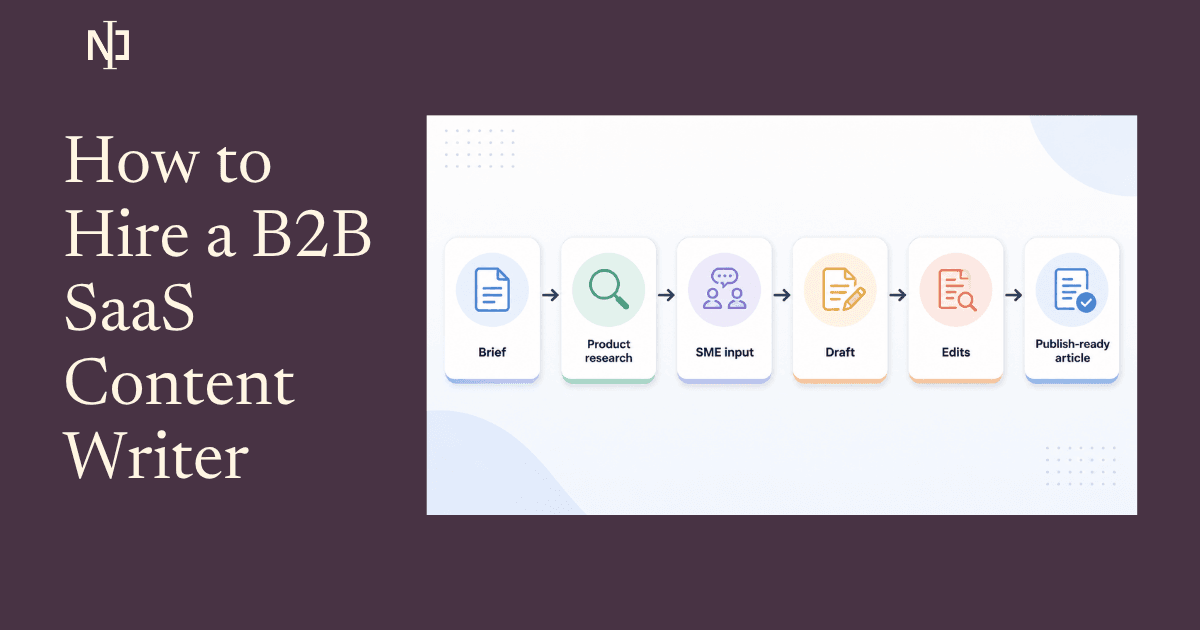
You want to know how they move from brief to draft. A good answer should include some mix of SERP research, product research, customer research, SME input, outlining, drafting, optimization, and revisions.
How do you write when we do not have access to an SME?
SMEs are busy and aren’t always available.. A strong writer should be able to use product docs, sales calls, customer reviews, webinars, public interviews, competitor pages, and other sources to build context.
How do you learn a new SaaS product?
Listen for curiosity. The writer should want to understand who uses the product, what problem it solves, how it differs, and what buyers often misunderstand.
How do you approach product-led content?
A good answer should not be, “I add product mentions throughout the article.” Product-led content should connect the product to the reader’s problem in a way that feels useful.
How do you handle bottom-funnel topics like comparisons and alternatives?
The writer’s answer reveals whether they understand decision-stage content. They should know how to handle competitors fairly, address objections, and help readers evaluate options.
How do you optimize for Google and AI search?
The answer should include more than keyword placement. Look for structure, clarity, concise answers, entity coverage, examples, expert input, and content that adds something beyond what already exists.
Can you share examples tied to business outcomes?
Not every writer has access to client analytics, but they should be able to discuss the goal behind a piece. Was it meant to rank? Support sales? Increase signups? Explain a use case? Refresh declining traffic?
What do you need from us to do your best work?
Strong writers know what inputs they need. Weak ones pretend they can work magic with no context.
What types of content are you not the best fit for?
This is one of the most underrated questions. Good writers know their strengths. If someone claims they can write every content type for every industry at every level of depth, be careful.
Red flags to watch out for when hiring a freelance B2B saas writer
The wrong writer will often reveal themselves before the first draft if you know what to look for.
The biggest red flag is not a typo in a sample. It is a writer who treats your SaaS product like any other topic on the internet.
Watch out for writers who only talk about traffic. Traffic is useful, but SaaS companies also need content that attracts the right audience and supports the buyer journey. If a writer never asks about pipeline, demos, trials, conversions, sales enablement, or product positioning, they may be thinking too narrowly.
Another red flag is a vague process.
If their process is basically “research, write, edit,” ask follow-up questions.
What kind of research? How do they evaluate sources? How do they use your product? How do they incorporate expert input?
Generic samples are another warning sign.
If every article feels like it could belong to any company in the category, the writer may struggle to create differentiated content.
Be careful with writers who do not ask about your product, ICP, competitors, or goals.
Good SaaS writers are curious. They know the brief rarely contains everything they need.
Also, avoid anyone who guarantees rankings. A writer can improve your chances of ranking by creating a strong, search-aligned piece, but they do not control Google, competitors, backlinks, domain authority, or algorithm updates.
AI use is not automatically a red flag. But overreliance on AI is. If the writer cannot explain how they add original research, product context, examples, interviews, or judgment, the output may feel like everything else online.
Finally, be cautious when a rate feels unrealistically low for the work required. Cheap content can become expensive when your team has to rewrite it.
How much does a B2B SaaS content writer cost?
B2B SaaS content writers can charge anywhere from a few hundred dollars to $1,500+ per article.
That range is wide because not every article requires the same level of thinking.
A simple top-of-funnel article with a detailed brief, clear sources, and a straightforward topic may not need a senior specialist. A generalist or entry-level writer can often handle that kind of work, especially if your editor is willing to shape the piece after the first draft.
But the more strategic the article, the more expensive the writer usually becomes.
A mid-level SaaS writer may be a good fit for standard blog posts, SEO articles, and content refreshes. They understand SaaS basics, can follow a brief, and can usually produce a solid draft with some editorial guidance.
An expert freelance B2B writer costs more because they are not just writing the article. They are thinking through the buyer, product, search intent, positioning, competitors, use cases, and business goal behind the piece.
That difference becomes obvious with bottom-funnel content.
A $300 article may summarize the top-ranking pages, include basic examples, and follow the brief. That may be fine for a low-stakes article.
A $1,200 article should go deeper. It may include product research, SME input, customer pain points, competitive context, screenshots, clearer positioning, sharper examples, and a draft that needs fewer edits before publishing.
The same applies when you hire someone for strategy plus writing. If the writer is helping you choose topics, shape briefs, identify content gaps, or recommend better angles, you are paying for judgment, not just words.
Freelancer, agency, or full-time SaaS writer?
For most B2B SaaS teams, a specialist freelancer is the best place to start.
Hire a freelancer when you have strategy but need execution
A freelance B2B SaaS writer makes sense when you already know which topics to target, which keywords matter, and what the content calendar looks like.
What you need is a senior writer who can turn briefs into publish-ready articles without heavy editing.
The biggest advantage is flexibility. You can bring in a freelancer for the exact gap you have: bottom-funnel content, product-led articles, comparison pages, content refreshes, SME-led posts, or technical SaaS topics.
A freelancer is also usually more cost-effective than an agency or full-time hire. You are not paying for account managers, agency overhead, benefits, onboarding, equipment, or idle time. You are paying for the work you need, when you need it.
You also get direct access to the person doing the work. There is no account manager between you and the writer. You can share context once, build a repeatable workflow, and work with someone who gets sharper as they learn your product, audience, and editorial preferences.
Another advantage is speed. Hiring full-time can take months. Agencies may require longer onboarding and larger retainers. A freelancer can often start with one paid test piece or a small pilot, then scale into a monthly retainer if the fit is strong.
Hire an agency when you need more than writing
An agency can make sense if you need strategy, editing, design, reporting, project management, and production at scale.
The tradeoff is cost and communication. You will usually pay more, and you may not always work directly with the person writing the content.
Hire full-time when content needs constant internal ownership
A full-time writer makes sense when content is a core growth channel, and you have enough ongoing work to justify the salary, onboarding, management, and long-term commitment.
But if your strategy is clear and your main problem is execution, start with a freelance B2B SaaS writer. It is usually the simplest way to get better content out the door without adding headcount or managing a larger agency relationship.
What to give your SaaS content writer before they start
A good writer can do a lot, but they should not have to reverse-engineer your entire business from your homepage.
The better the input, the better the draft.
Before a writer starts, give them:
- Your ICP or buyer personas
- Product positioning
- Access to the product or a recorded demo
- Sales call recordings
- Customer research
- Competitor context
- Content briefs
- Brand voice guidelines
- SME access, if available
- Examples of content you like and dislike
- Internal linking priorities
- The goal of the piece
- The funnel stage of the article
- Notes on what the article should not say
Hiring a writer without context is like asking a chef to cook dinner without telling them who is eating, what ingredients are available, or whether anyone has allergies.
Yes, the chef should know how to cook. But context changes the meal.
The same is true for content. A strong writer can improve a weak brief, but they still need enough information to make smart decisions.
For B2B SaaS in particular, product access is underrated. If the writer can see the product, watch workflows, review screenshots, or understand how users complete tasks, the content will usually be more specific and useful.
How to start working with a B2B SaaS writer
Instead of jumping straight into a long retainer, begin with one paid article or a short pilot.
The pilot gives you both a chance to test the working relationship before committing to more.
Pick a topic you would actually publish. Not a random “write 500 words about our industry” test. If you’re hiring the writer for bottom-funnel content, give them a bottom-funnel topic. If you need product-led SEO content, give them a product-led brief.
Then review more than the writing.
Ask yourself:
- Did they understand the search intent?
- Did they ask smart questions?
- Did they explain the product accurately?
- Did they use specific examples?
- Did they structure the piece well?
- Did the draft move the article closer to publish-ready?
- Did they make your job easier?
After the first piece, give clear feedback. Point out what worked, what missed the mark, and what you’d want them to do differently next time. Then watch how they respond.
Some writers are strong from the first draft. Others become much better once they understand your product, audience, internal language, and editorial preferences.
Move to a retainer once the writer has improved speed, quality, and consistency. A good retainer should not feel like buying a fixed number of articles. It should feel like adding dependable content capacity to your team.
Before you hire
A good B2B SaaS content writer does more than write clean sentences.
You need someone who understands your product, your buyers, and the role each article plays in the sales process.
So before you hire, look beyond samples and rates. Ask about their process. Look for product understanding. Pay attention to how they think, not just how they write.
Start with a paid test piece. Keep working with the writer if the drafts get sharper, the edits get lighter, and the content starts doing its job.
And if you need help with bottom-funnel SEO content, product-led articles, comparison and alternatives articles, or content refreshes, that’s the kind of work I do.
I’m Nathan Ojaokomo. I help B2B software companies create content that ranks, earns trust, and supports pipeline.
Let’s talk about your content.
FAQs
What does a B2B SaaS content writer do?
A B2B SaaS content writer creates content for software companies that sell to other businesses. This content can include blog posts, SEO articles, product-led content, LinkedIn content, comparison pages, alternative posts, use case articles, content refreshes, case studies, newsletters, and sales enablement content.
How much does a freelance B2B content writer cost?
B2B SaaS content writers can charge anywhere from a few hundred dollars to $1,500+ per article, depending on experience, niche, research depth, content type, and scope.
Specialist writers usually cost more than generalists, especially for bottom-funnel content, technical SaaS topics, product-led articles, SME interviews, and content tied to the pipeline.
Where can I find B2B SaaS content writers?
You can find freelance SaaS content writers through referrals, LinkedIn, writer websites, bylines on SaaS blogs, niche communities, and curated writer lists.
Freelance marketplaces can work, but be careful not to filter only by price. For SaaS content, specialization and process are often better signals than the lowest rate.
Should I hire a freelance SaaS writer or a content agency?
Hire a freelance SaaS writer if you need specialist execution, direct communication, and flexible capacity.
Hire a content agency if you need strategy, editing, project management, design, reporting, and larger-scale production.
For many SaaS teams, a specialist freelancer is the better first hire when the strategy is already clear, and the main need is high-quality execution.
What should I include in a SaaS content brief?
A strong SaaS content brief should include the target keyword, search intent, audience, funnel stage, content goal, product angle, internal links, competitors, examples to reference, points to avoid, brand voice notes, and any SME or customer insights.
The brief does not need to answer everything, but it should give the writer enough context to make smart decisions.